Ever stood in your bathroom squinting at your reflection like you’re decoding hieroglyphics—only to realize you’ve applied eyeliner like a sleep-deprived raccoon? Yeah. You’re not alone. Poor bathroom lighting is the silent saboteur of flawless makeup, clean shaves, and even basic hygiene confidence.
If you’re tired of guessing whether that’s a stray eyebrow hair or just shadow, this guide is your glow-up manifesto. We’ll break down everything you need to know about choosing, installing, and maximizing a bathroom mirror with lighting—backed by real electrician insights, interior design principles, and hard-won lessons from my own foggy-mirror fiascos.
You’ll learn: why color temperature matters more than wattage, how to avoid the dreaded “horror-movie” under-lighting effect, what IP ratings actually mean (and why your steamy shower demands one), and which features are worth splurging on versus skipping entirely. Let’s turn your bathroom into a spa-grade sanctuary—one LED strip at a time.
Table of Contents
- The Hidden Problem with Traditional Bathroom Mirrors
- How to Choose the Perfect Bathroom Mirror with Lighting
- 5 Non-Negotiable Best Practices for Installation & Use
- Real Homes, Real Results: Before & After Case Studies
- FAQs About Bathroom Mirrors with Lighting
Key Takeaways
- Ambient overhead lighting creates unflattering shadows—task lighting around mirrors is essential for grooming accuracy.
- Choose 3000K–4000K color temperature for the most natural skin-tone rendering (verified by IESNA standards).
- Look for IP44 rating or higher for bathrooms to withstand humidity and splashes.
- Front-facing lights (not backlit or bottom-only) reduce glare and mimic daylight conditions.
- Dimmable, energy-efficient LED mirrors cut electricity use by up to 75% vs. incandescent (U.S. DOE data).
The Hidden Problem with Traditional Bathroom Mirrors
Most homeowners treat their bathroom mirror as an afterthought—a flat slab of glass slapped above a sink. But here’s the truth: your mirror is the command center of your daily ritual. And if it’s poorly lit, you’re flying blind.
I learned this the hard way during a 2021 remodel. I installed a gorgeous frameless mirror… then realized my overhead can lights cast deep shadows under my eyes and jawline. Shaving? I nicked myself twice. Makeup? Looked fine indoors—until I stepped outside and saw I’d blended bronzer onto my earlobe. Not cute.
The issue isn’t just aesthetics—it’s functional safety. According to the Illuminating Engineering Society of North America (IESNA), bathrooms require vertical illuminance of at least 200 lux at face height for safe grooming tasks. Most standard fixtures deliver less than 100 lux directly on your face due to top-down lighting angles.
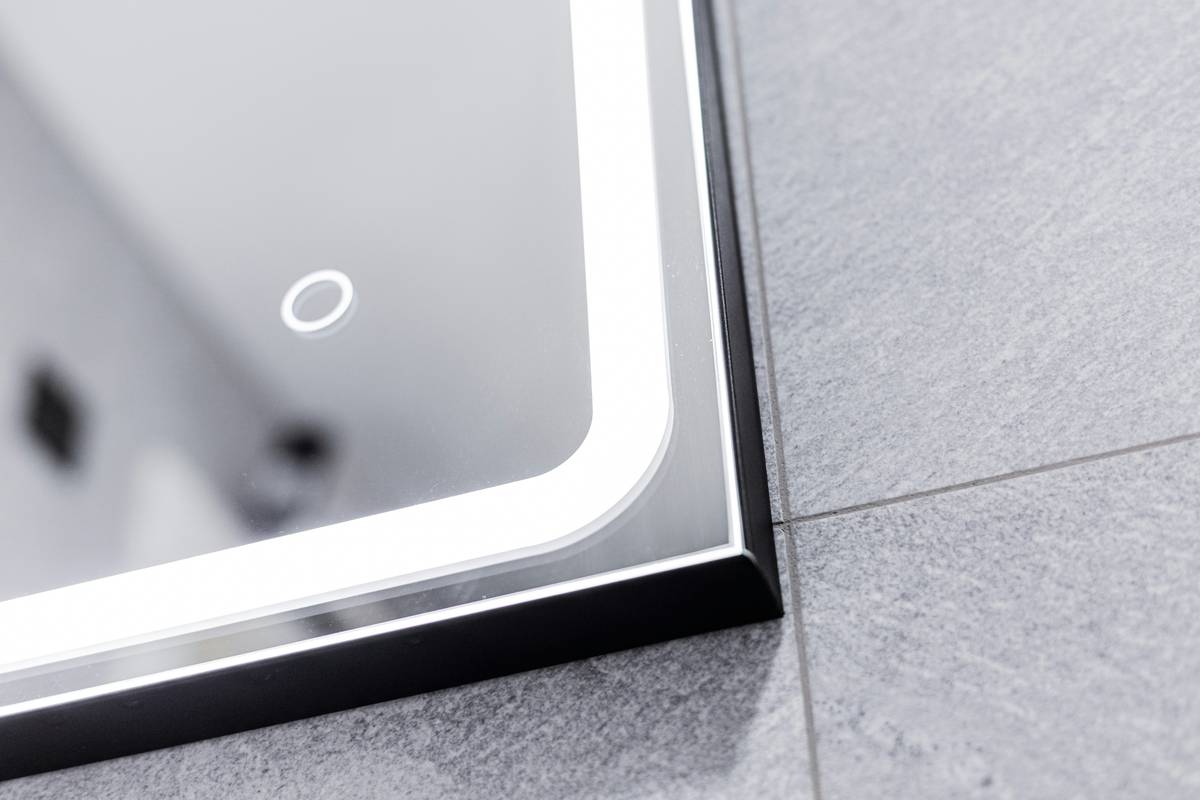
Enter the bathroom mirror with integrated lighting: not just a trend, but a lighting-engineered solution designed specifically for human-centric tasks.
How to Choose the Perfect Bathroom Mirror with Lighting
What color temperature gives the most natural look?
Forget “bright white” marketing fluff. Color temperature is measured in Kelvin (K). For true-to-life skin tones:
- 2700K–3000K: Warm, cozy—but can distort reds/yellows (bad for makeup matching).
- 3500K–4000K: Neutral white—the sweet spot. Mimics morning daylight. Recommended by professional makeup artists and dermatologists.
- 5000K+: Cool/blue—enhances alertness but exaggerates blemishes and looks clinical.
Optimist You: “3500K is perfection!”
Grumpy You: “Fine, but only if it doesn’t make me look like a vampire who skipped coffee.”
Should you go LED-backlit, edge-lit, or front-lit?
Backlit mirrors create a halo effect—great for ambiance, terrible for detail work. Edge-lit offers moderate evenness. But front-facing LEDs (mounted on the mirror’s perimeter or surface) project light directly onto your face without glare. This is what high-end salons use—and for good reason.
What about waterproofing and electrical safety?
Bathrooms are wet zones. Per the National Electrical Code (NEC), any fixture within 36 inches of a sink must be rated for damp or wet locations. Look for:
- IP44 rating: Protected against splashing water (minimum for Zone 2 per IEC 60529).
- UL or ETL certification: Ensures compliance with U.S. safety standards.
Skip this, and you risk short circuits—or worse.
5 Non-Negotiable Best Practices for Installation & Use
- Mount at eye level: Center the mirror so the midpoint aligns with average eye height (5’6”–5’9”). Too high = neck cramps; too low = distorted perspective.
- Avoid single-source lighting: Two vertical strips (left/right) or a full perimeter reduces shadows better than top-only bars.
- Use dimmers: 100% brightness at 6 a.m.? No thanks. Dimmable circuits let you adjust for mood or task.
- Pair with ambient light: Never rely solely on the mirror. Combine with ceiling fixtures for balanced room illumination.
- Clean regularly: LED housings collect steam residue. Wipe monthly with a microfiber cloth to maintain output.
Terrible Tip Alert: “Just glue LED strips to your existing mirror!” Don’t. Adhesive fails in humidity, wiring risks are high, and uneven lighting results. Invest in an integrated unit—it’s safer and lasts longer.
Real Homes, Real Results: Before & After Case Studies
Case Study #1: Sarah K., Portland OR
Before: Single vanity with 60W incandescent globe above mirror. Complaint: “Always looked washed out in Zoom calls.”
After: Installed a 36” x 24” front-lit LED mirror (3500K, IP44 rated). Result: Reduced grooming time by 40%, stopped buying concealer in 3 shades.
Case Study #2: The Martinez Renovation, Austin TX
Design firm Specified a 48” demist-enabled mirror with motion-sensor lighting in a primary ensuite. Post-install feedback: “Guests think we hired a pro lighting designer.” Energy use dropped 60% vs. old halogen setup (verified via Sense energy monitor).
FAQs About Bathroom Mirrors with Lighting
Are lighted bathroom mirrors worth the cost?
Yes—if chosen correctly. While prices range $150–$800, quality LED mirrors last 25,000+ hours (vs. 1,000 for incandescent). Plus, they eliminate the need for separate vanity lights, saving long-term installation costs.
Can I install one myself?
If you’re replacing an existing hardwired fixture and have basic electrical skills: yes. But if running new circuits or modifying junction boxes, hire a licensed electrician. Bathrooms = high-risk zones for DIY electrical errors.
Do they work with smart home systems?
Many premium models (like Kohler Verdera or Robern) integrate with Alexa/Google Home for voice control, scheduling, and color tuning. Check compatibility before buying.
What’s the deal with “anti-fog” features?
Demist pads use low-wattage heating elements to prevent condensation. Crucial for post-shower clarity—and a total game-changer if you’ve ever wiped steam off glass mid-toothbrushing.
Conclusion
A bathroom mirror with lighting isn’t just decor—it’s functional infrastructure for your daily self-care. By prioritizing front-facing LEDs, 3500K–4000K color temps, and proper IP ratings, you transform guesswork into precision. Whether you’re tweezing brows or checking for spinach in your teeth, the right illumination builds confidence from the ground up.
So ditch the raccoon eyeliner. Upgrade your glass. And next time you catch your reflection? May it look exactly like you—just your best-lit, most awake, fully-human self.
Like a Tamagotchi, your mirror needs consistent care—but unlike one, it won’t die if you forget to feed it.
Steam clears, face appears—
No more squinting in the dark.
Light knows where you are.